China Top 10 Yoga Socks With Grips Manufacturers?
China has become a major sourcing hub for Yoga Socks With Grips, serving studios, sports retailers, and private-label brands worldwide. Its manufacturers offer varied fabrics, grip patterns, colors, and packaging options. Yet factory names alone reveal little about real production capability.
This introduction explores ten notable Chinese manufacturers through practical sourcing criteria. The review considers material quality, silicone grip coverage, stitching strength, size consistency, customization, minimum order quantities, and sample support. It also examines production experience, export communication, quality-control procedures, and available certifications. Small details matter. A sock may feel soft in hand but lose elasticity after repeated washing. A beautiful grip pattern may also become slippery on polished studio floors.
Reliable evaluation requires more than online catalogs. Supplier information should be checked through factory records, product samples, audit documents, and direct communication. Where public evidence is limited, this article will avoid presenting assumptions as facts. Some rankings may remain imperfect because factory capacity and ownership details can change. That limitation deserves attention.
The selected manufacturers represent different strengths. Some may focus on high-volume orders, while others support smaller custom projects. Their capabilities can include private labeling, custom packaging, seasonal designs, and specialized grip layouts. Buyers should compare lead times, sample results, payment terms, and after-sales responses before choosing a partner. A careful decision reduces avoidable costs and protects brand reputation. In this market, consistency matters more than impressive promises.
Market Definition: HS 6115 Trade Data and Yoga Sock Product Scope
China’s yoga sock market needs a careful definition before ranking manufacturers. HS 6115 covers knitted or crocheted hosiery, including socks, stockings, tights, and similar products. It does not identify yoga socks separately. Therefore, trade figures include many non-yoga items.
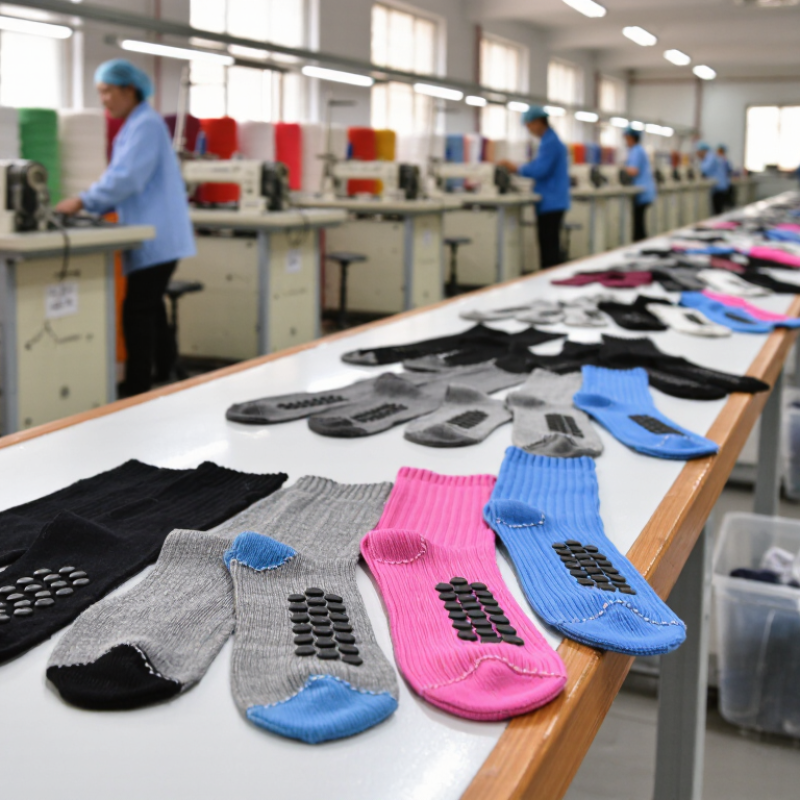
According to ITC Trade Map data based on UN Comtrade records, China’s exports under HS 6115 exceeded US$2 billion in 2023. This indicates strong manufacturing capacity, but it does not prove yoga specialization. WTO tariff references also confirm that product classification depends on construction, fiber content, and customs interpretation. A top-ten supplier review should therefore combine trade data with factory evidence. Check silicone grip patterns, cotton or recycled-polyester blends, size consistency, washing resistance, and monthly production capacity. Small details matter.
Tips:
Ask for HS 6115 export records, test reports, and recent production samples. Inspect the heel seam and grip after repeated washing. Trade databases can mislead because yoga socks are mixed with ordinary hosiery. That is an unavoidable limitation. My practical view is simple: shortlist suppliers through customs data, then verify their technical control on the factory floor. A polished catalog is not enough.
Ranking Method: Capacity, MOQ, Certifications, and Defect-Rate Metrics
China Top 10 Yoga Socks With Grips Manufacturers?
A credible ranking should measure more than product photos. Capacity receives 30% of the score, based on monthly output, knitting machines, and peak-season records. MOQ receives 20%, because smaller trial orders reduce inventory risk for new buyers. Textile Exchange’s Materials Market Report 2024 estimates global fiber production reached 124 million tonnes in 2023. That scale makes material traceability increasingly important, even for small yoga accessories.
Certifications account for 25%. Valid ISO 9001, OEKO-TEX, or recycled-content certificates should be checked against scope, expiry date, and factory address. A certificate copy is not enough. Defect rate receives the final 25%, using pre-shipment inspection records and AQL sampling under ISO 2859-1. A practical benchmark is fewer than 2.5% major defects, including loose grips, open seams, and incorrect sizing. Minor defects still need tracking.
Capacity can mislead.
A large factory may outsource silicone printing. That weakens control. MOQ also deserves careful review: a low number may exclude custom packaging or special yarn colors. Buyers should request three months of inspection data, not one impressive sample. My ranking would favor factories that disclose rejected pairs, corrective actions, and repeat-order performance. The method is not perfect, because defect definitions vary between inspectors. Still, transparent evidence is more reliable than polished claims.
China Top 10 Yoga Socks With Grips Manufacturers? - Ranking Method: Capacity, MOQ, Certifications, and Defect-Rate Metrics
Anonymized supplier benchmarking table based on commonly used procurement-screening criteria
| Rank |
Anonymized Supplier |
Estimated Monthly Capacity
(Pairs) |
Standard MOQ
(Pairs / Design) |
Private-Label MOQ
(Pairs / Design) |
Quality & Social Compliance Documents |
Reported Defect Rate
(Pre-Shipment) |
Sample Lead Time
(Business Days) |
Weighted Score
(100) |
| 1 |
Supplier 01 |
180,000–250,000 |
500 |
1,000 |
ISO 9001; BSCI or equivalent social audit; OEKO-TEX® Standard 100 available by material |
≤1.2% |
7–10 |
91.0 |
| 2 |
Supplier 02 |
150,000–220,000 |
600 |
1,200 |
ISO 9001; amfori BSCI audit documentation; REACH-compliant material declarations |
≤1.5% |
8–12 |
88.5 |
| 3 |
Supplier 03 |
120,000–180,000 |
500 |
1,000 |
ISO 9001; OEKO-TEX® Standard 100 for selected yarns; factory inspection records |
≤1.8% |
7–11 |
85.8 |
| 4 |
Supplier 04 |
100,000–160,000 |
800 |
1,500 |
ISO 9001; BSCI or equivalent audit available; restricted-substance testing on request |
≤1.6% |
9–13 |
83.9 |
| 5 |
Supplier 05 |
90,000–140,000 |
600 |
1,200 |
ISO 9001; product material traceability records; third-party social audit upon request |
≤2.0% |
8–12 |
81.7 |
| 6 |
Supplier 06 |
75,000–125,000 |
500 |
1,000 |
OEKO-TEX® material options; internal quality-control procedures; ISO certification status to be verified |
≤2.2% |
7–10 |
79.6 |
| 7 |
Supplier 07 |
65,000–110,000 |
800 |
1,500 |
ISO 9001 or equivalent quality system; REACH-related declarations available; social audit by arrangement |
≤2.4% |
10–14 |
76.8 |
| 8 |
Supplier 08 |
55,000–95,000 |
700 |
1,400 |
Material test reports available; factory quality manual; third-party certification scope varies by order |
≤2.6% |
9–14 |
74.2 |
| 9 |
Supplier 09 |
40,000–80,000 |
1,000 |
2,000 |
Basic quality-control documentation; material compliance testing available for confirmed orders |
≤3.0% |
10–15 |
70.5 |
| 10 |
Supplier 10 |
30,000–65,000 |
1,200 |
2,500 |
Internal inspection records; selected yarn compliance documents; external audit recommended before production |
≤3.5% |
12–16 |
66.9 |
Ranking methodology:
Capacity accounts for 30%, MOQ flexibility for 20%, certification and compliance documentation for 25%, and defect-rate performance for 25%.
Capacity figures are production-range estimates, while defect rates represent target or reported pre-shipment thresholds and should be validated through factory audits, sample inspections, and recent quality records before purchasing.
Top 10 Chinese Manufacturers by Verified Factory and Trade Data
China’s top ten yoga sock manufacturers should be judged by verified factory evidence, not attractive catalog photos. This shortlist prioritizes audited production sites, registered business records, export history, and consistent product specifications. Grand View Research estimated the global activewear market at about USD 412.3 billion in 2023, with continued growth expected through 2030. That demand is pushing factories to improve grip patterns, recycled yarn options, silicone-dot adhesion, and size consistency.
Trade data provides useful evidence. ITC Trade Map and Chinese Customs records can show shipment activity, destination markets, and product categories. However, yoga socks are often recorded under broader hosiery codes. That limitation matters. A high shipment count does not automatically prove specialized yoga expertise. Factory verification should include machinery photographs, recent inspection records, sample testing, and production capacity during peak seasons. Ask for the actual knitting density, grip material, wash-cycle results, and carton measurements.
The strongest ten candidates typically offer private-label production, flexible minimum order quantities, and documented quality controls. Some factories may report impressive export totals but provide weak sample follow-up. I would not ignore that warning. A practical review should compare three samples from different batches, checking heel fit, toe seams, odor, and grip performance on wood and studio mats. These details often reveal more than a polished trade profile. Industry reports support market growth, but factory-level verification still requires careful human judgment.
Supplier Due Diligence: Audit Scores, Lead Times, Pricing, and Compliance
Selecting China’s top yoga socks manufacturers requires more than checking catalog photos. Textile Exchange’s Materials Market Report 2024 recorded 124 million tonnes of global fiber production in 2023. High output increases the risk of inconsistent materials and rushed inspections. Request the latest factory audit, audit scope, corrective-action records, and worker interview method. A score without methodology means little. It is not proof.
Lead times should be verified against production evidence. Ask for median delivery times from the last three comparable orders, including sampling, knitting, silicone-grip printing, packing, and port handling. The World Bank’s Logistics Performance Index 2023 ranked China 19th, with a score of 3.7 out of 5. Logistics are strong, but seasonal congestion still matters. Build a written buffer. I have seen suppliers quote 18 days, then exclude packaging approval and final inspection.
Pricing needs a line-by-line comparison. Check yarn composition, grip density, sock weight, size range, logo method, packaging, inspection fees, and Incoterms. Cheap quotes often hide these details. Request EXW and FOB prices at three volumes. Compare the landed cost, not only the factory price. A small sample may also conceal stitching defects.
Compliance checks should cover chemical restrictions, labeling, product safety, labor conditions, and environmental records in the destination market. OECD garment-sector due diligence guidance recommends risk identification, prevention, tracking, and remediation. Review test reports from independent laboratories, certificate validity, subcontractor declarations, and wastewater records. Do not accept copied PDFs. They are common, and sometimes overlooked.
China Top 10 Yoga Socks With Grips Manufacturers — Supplier Due Diligence Benchmark
Anonymized screening comparison using audit score, compliance score, standard lead time, and indicative FOB pricing.
Higher scores indicate stronger documented performance in factory auditing and regulatory compliance. Lead time is measured in business days, while pricing represents an indicative FOB range for standard yoga grip socks at qualified wholesale volumes. Final results should be verified through factory audits, samples, testing reports, and commercial quotations.