How to Source the Best Non Slip Yoga Socks in 2026?
Sourcing dependable Non Slip Yoga Socks in 2026 takes more than comparing prices or counting silicone dots. A pair may feel secure on a showroom floor, then slide on a damp studio mat. Ask suppliers for material specifications, grip-pattern details, and test results on both dry and lightly damp surfaces. Request samples from the actual production line, not just a polished prototype. Then wash them and check whether the grips crack, peel, or lose their hold.
Yoga teacher and author B.K.S. Iyengar wrote, “Yoga is a light, which once lit will never dim. The better your practice, the brighter your flame.” His words speak to the practice, not sock manufacturing, but they remind buyers that comfort and confidence affect movement. In sourcing, small details count: a heel that stays in place, seams that do not rub, and fabric that breathes through a warm class. Ask how each claim is verified. A supplier’s brochure is not a test report.
This guide looks at construction, fit, traction, durability, and supplier checks for 2026. It also considers practical trade-offs between grip coverage, comfort, and cost. Not every sample will pass. That is useful. Real testing can expose weaknesses before a bulk order makes them expensive.
Define Performance Requirements for Non-Slip Yoga Socks
How to Source the Best Non Slip Yoga Socks in 2026?
Define Performance Requirements for Non-Slip Yoga Socks
Start with the surface and movement, not the pattern of silicone dots. A sock used on a dry studio floor needs reliable traction during lunges and pivots. A home routine on polished wood may need a different grip profile. Ask suppliers for test results on representative surfaces, under dry and damp conditions. ASTM F2913 measures footwear friction against test surfaces; it is not a sock-specific certification. Treat it as a useful reference, not proof that a sock will perform in every class.
Set measurable requirements for grip, fit, and durability. The sole should resist sliding without locking the foot so firmly that turning feels awkward. Check whether grip elements remain attached after repeated washing, and whether seams rub between the toes. Small details matter. The Yoga Alliance and Ipsos 2022 Yoga in America Study estimated 34.4 million U.S. practitioners, a broad user base with varied routines and needs. That figure does not define sock performance, but it cautions against designing for one idealized user. Request abrasion, wash-cycle, and friction data, plus the test methods and conditions. A sample can feel excellent on a showroom mat, yet disappoint after several washes. That is worth questioning.
Assess Materials, Grip Patterns, Fit, and Construction
When sourcing non-slip yoga socks in 2026, request exact fiber percentages, not vague “breathable” claims. Textile Exchange’s Materials Market Report 2024 estimates polyester made up 57% of global fiber production in 2023, while cotton accounted for 20%. These figures describe the wider market, not sock quality. For practice, compare cotton-rich blends for a soft feel with synthetic fibers that may dry faster, then verify moisture-management claims through testing such as AATCC TM195.
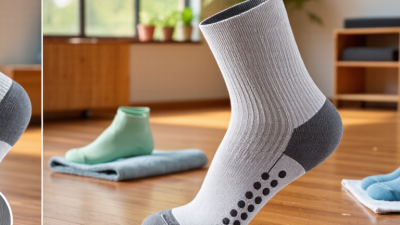
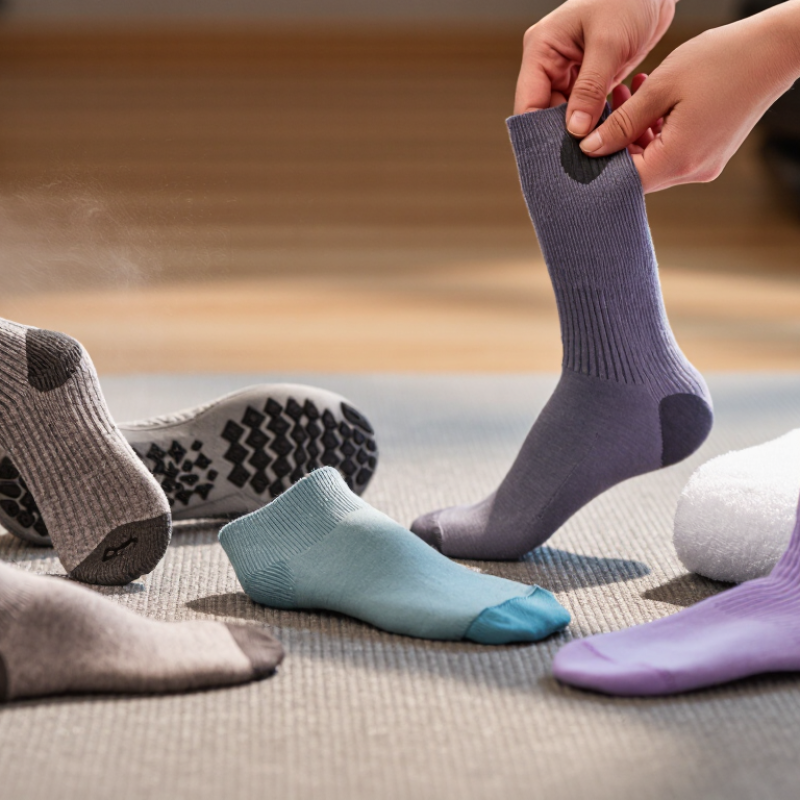
Grip depends on more than the number of silicone dots. Ask suppliers for test results on dry and lightly damp surfaces, plus grip retention after repeated washing. ASTM F2913 measures footwear slip resistance, but socks are not shoes; any adapted test should clearly state its surface, load, and method. Small details matter. Raised grip may feel secure on a studio floor yet become uncomfortable inside a tight shoe. Check dot spacing, coverage under the heel and forefoot, and whether the pattern cracks or peels.
Fit and construction deserve equal scrutiny. Request measurements across the stated size range, then check heel-pocket depth, toe seams, and stretch recovery on actual samples. A sock that twists during a lunge is not a good fit, even if its size label looks right. Inspect stitching and grip placement after wash testing, not just on a fresh sample. One caveat: a convincing first impression is easy to overvalue. Ask for documented results, and treat unsupported performance claims cautiously.
Identify and Verify Potential Suppliers
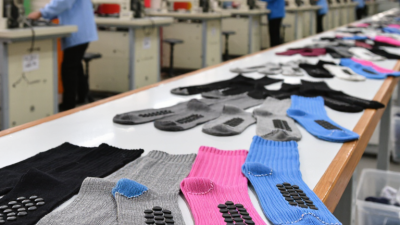
Start with suppliers that make performance socks or closely related knitwear. Ask about their experience with yoga socks, production capacity, minimum order quantity, and typical lead time. Request a written specification for yarn composition, silicone grip pattern, sizing, and packaging. Specific answers are more useful than broad claims. Check that the business name, factory address, and contact details match across its quotation, website, and sample documents.
Tips: Request samples from two or three suppliers. Compare grip placement, seam comfort, and fabric stretch on a clean studio floor. Wash each pair according to its care label, then check whether the grips peel or feel slick. Ask for recent production photos or a live video call. Verify any test reports directly with the issuing laboratory, and confirm that the report covers the exact material or product offered. A certificate alone proves little if its scope is unclear.
Before ordering, ask how the supplier checks size consistency and grip adhesion during production. Request references from recent buyers, but treat testimonials as a starting point, not proof. A small trial order can reveal packing errors and communication delays. It costs more per pair. Still, that lesson may be cheaper than a large order with uneven sizing. I would record each supplier’s answers in one comparison sheet; memory gets unreliable quickly.
Test Product Quality, Safety, and Durability
How to Source the Best Non Slip Yoga Socks in 2026?
Test Product Quality, Safety, and Durability
A confident product description is not proof of dependable grip. Request material details, construction information, and recent test records from each supplier. Check whether grip patterns cover the heel and forefoot, where socks may shift during poses. Examine seams inside the toe area; rough stitching can distract during balance work. Ask how sizing is checked across production batches. A sample may fit well, while later pairs run tighter. That happens.
Assess safety with practical checks and clear documentation. Test socks on a clean, dry studio floor, using the same basic movements each time. Look for bunching, sudden sliding, or pressure marks after a short session. Ask about material composition and care instructions, especially if customers may have sensitivities. If a supplier provides laboratory results, confirm what was tested and under which conditions. A single test cannot represent every floor or user.
Tips: Wash samples according to the label, then inspect them after several cycles. Check for peeling grips, loose threads, fading, and noticeable shrinkage. Keep notes and compare multiple pairs from the same batch. Don’t rely on appearance alone. A grip can look intact but feel less secure underfoot. If results vary, request another sample and investigate before placing a large order.
How to Source the Best Non-Slip Yoga Socks in 2026
Suggested minimum screening grades for durability and colorfastness tests. These are buyer-set targets, not universal standards or measured results.
Grades use a 1–5 scale, with 5 representing the best result. Suggested checks: pilling resistance (ISO 12945-2), color change (ISO 105-A02), and staining (ISO 105-A03). For non-slip performance, ask for dry and wet traction tests on representative flooring; there is no single universal pass value shown here.
Compare Pricing, Minimum Orders, and Supplier Reliability
A low unit price can hide setup fees, packaging costs, or expensive freight. Compare the landed cost per pair, not just the factory quote. Ask whether prices change with sock size, grip pattern, yarn blend, or custom labels. Small details matter. Request a written quotation with each charge listed, then compare suppliers using the same specifications.
Minimum order quantities can strain cash flow, especially when testing several colors or sizes. Ask whether the supplier allows a mixed-size trial order, and check if samples cost extra. A smaller opening order may carry a higher unit price, but it can reveal fit and grip problems before a larger commitment. It is easy to focus too much on the cheapest sample; production quality may differ.
Supplier reliability needs evidence, not warm promises. Ask for recent production photos, lead-time estimates, and details on how defects are handled. Ask for proof. Confirm that the sample matches the agreed grip layout and fabric before approving production. Clear answers are useful; vague replies about delivery deserve caution. One limitation: a polished sample cannot guarantee every pair will match. Consider a pre-shipment inspection, and keep written records of specifications, timelines, and agreed remedies.